
Coating Line Solutions for the Musical Instrument Industry: Perfecting Guitars and Pianos
Finishing a guitar body or a piano cabinet is the point where a coating line stops being generic equipment and becomes a process-matched system. The surface has to come out free of dust, uniform in film thickness, and protective enough for solid wood or MDF, while the line still runs at production speed. This guide explains how a Wood Coating Line is configured for the musical instrument industry, which parameters actually protect an instrument surface, and what a buyer should verify before committing to a new line or a line upgrade.
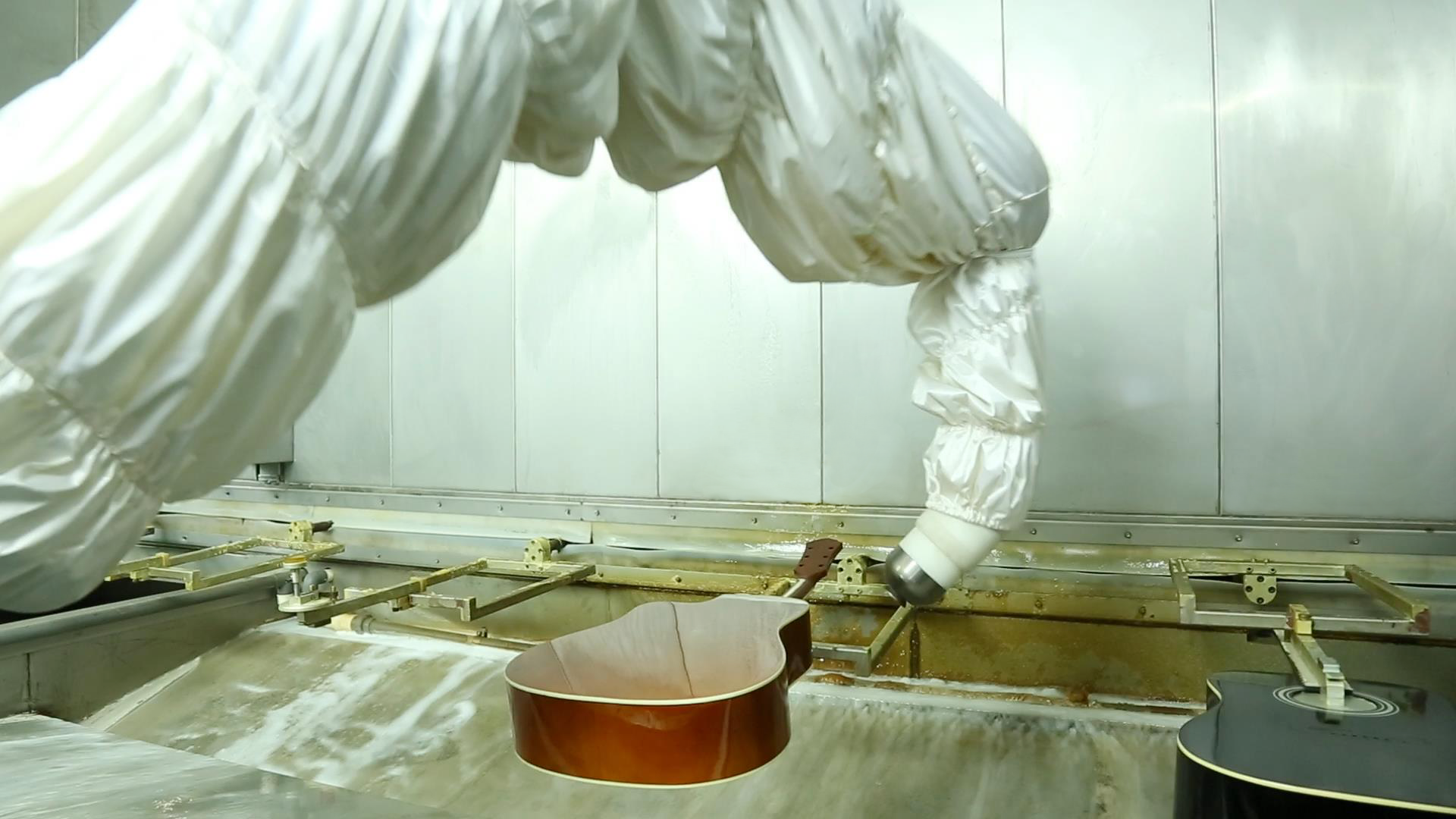
What Is a Coating Line for the Musical Instrument Industry?
A coating line for the musical instrument industry is an automated system that conveys workpieces through spraying, pre-heating, curing, and cooling stages instead of relying on an operator to spray every part by hand. In the Attractivechina product range, the machine that serves this application is the Wood Coating Line, described as a wood furniture automatic coating line intended for the wood furniture and musical instrument industry.
The Wood Coating Line belongs to a set of categories that map directly onto what instrument and furniture makers produce: guitar coating line, piano coating line, musical instruments coating line, wood beds coating line, dining tables coating line, wood chairs coating line, and wood speaker coating line. Its classification within the catalogue is a wood coating line, and its workpiece material is solid wood or MDF.
The typical workpiece types handled by the line include table legs, chair backs, sitting boards, front legs, sitting frames, and chairs. The same conveying and spraying concept carries over to instrument parts, which is why the musical instrument category sits inside the same product family rather than on a separate platform.
Attractivechina is the brand of Guangdong Chuangzhi Intelligent Equipment Co., Ltd., a coating equipment manufacturer established in 2005 in the High-tech District of Zhaoqing City, Guangdong Province, China. The company specialises in overall solutions for coating production lines, covering pre-sales plant planning, independent R&D, design, manufacturing, installation, commissioning, and after-sales service.
The Real Problem: Why Instrument Surfaces Are Hard to Finish
Instrument coating fails in ways that look small in a report and very large on a finished product. A single dust particle trapped under a topcoat shows up on a high-gloss guitar top. Uneven film thickness reads as orange peel or as a colour shift between adjacent piano panels. Slow or inconsistent curing leaves a surface that feels soft long after it should have hardened.
Three characteristics of instrument workpieces drive most of these defects.
- Mixed geometry on one line. A guitar body is curved, narrow, and often hollow at the edges, while a piano component can be a long flat panel or a heavy frame. A single conveying system has to hold both without marking the surface.
- Substrate differences. Solid wood and MDF absorb coating differently and react differently to heat. MDF edges absorb more finish than faces, and solid wood moves with moisture.
- Visual tolerance is close to zero. Instrument finishes are inspected by eye, frequently in raking light, so defects that a hidden structural part could tolerate are rejected on a visible panel.
For a plant moving from manual spraying to automated production, the practical question is not whether automation is faster. It is whether the line can hold the same surface quality across thousands of parts per shift, which is a question about conveying stability, spray environment, and line speed control working together.
Industry Background: Where the Demand for Instrument Coating Capacity Comes From
The equipment side of this industry is expanding. According to Fortune Business Insights, the global coating equipment market was valued at USD 20.56 billion in 2025 and is projected to reach USD 36.77 billion by 2034. The same source reports that Asia Pacific dominated the coating equipment market with a 38.30% revenue share in 2025, driven by automotive and EV sector growth. China, Vietnam, Indonesia, and India all appear in that expansion, and the same industrial base supports wood furniture and musical instrument production.
Two other market signals are relevant to anyone specifying a wood system. Fact.MR estimates the global powder coating equipment market at USD 3.20 billion in 2024, expected to grow at a CAGR of 5.1% through 2034. Market Reports World estimates the E-Coat (electrocoating) market at USD 6.02 billion in 2026, reaching USD 9.48 billion by 2035 at a 5.18% CAGR. Those figures are dominated by metal substrates, but they confirm the underlying direction: coating is being industrialised, and wood-based manufacturers are being measured against the same standards of repeatability that metal finishers already face.
The Solution in Detail: How the Wood Coating Line Is Built for Instruments
The Wood Coating Line addresses instrument finishing through a combination of adjustable conveying speed, a stainless-steel spray environment, and a defined throughput. The following specifications are the parameters that matter most for guitar and piano coating work.
Line Speed and Pitch: Adjustability Instead of a Fixed Output
The design line speed of the Wood Coating Line is 4000 mm/min, adjustable from 2000 mm/min to 6000 mm/min. That range is the single most useful feature for a mixed instrument workload. A smaller guitar part that needs a longer flash-off period can be run at the lower end of the range, while a stable, high-volume panel can run at the upper end without changing the line configuration. The pitch is 300 mm per hang, which sets how closely workpieces follow one another and, in turn, how much dwell time each part receives in each module.
Spray Booth and Materials of Construction
The main frame of the line is made of carbon steel, while the spray booth and the pipeline are made of stainless steel. For instrument coating this matters for two reasons. A stainless-steel booth resists the solvents and cleaning agents used in furniture and instrument finishing, and it supports the wipe-down discipline that keeps dust out of the spray zone. The stainless pipeline reduces contamination carried into the coating material, which is the kind of process detail that shows up later as fewer surface defects.
Workpiece Compatibility and Output
The line is dimensioned around real production parts. The standard workpiece size is 100 mm (L) × 50 mm (W) × 1400 mm (H), and the maximum workpiece size is 610 mm (L) × 710 mm (W) × 1400 mm (H). Workpiece material is solid wood or MDF. The 8-hour output per shift is 1422 pieces per shift, and the energy used is electricity.
Electric energy is a notable point for wood. Because the line runs on electricity rather than an open combustion source inside the process area, planning is simpler and the process is easier to integrate with an indoor production environment. The stated operating condition for this equipment family is an indoor Class 10,000 cleanroom with a clean and well-ventilated environment.
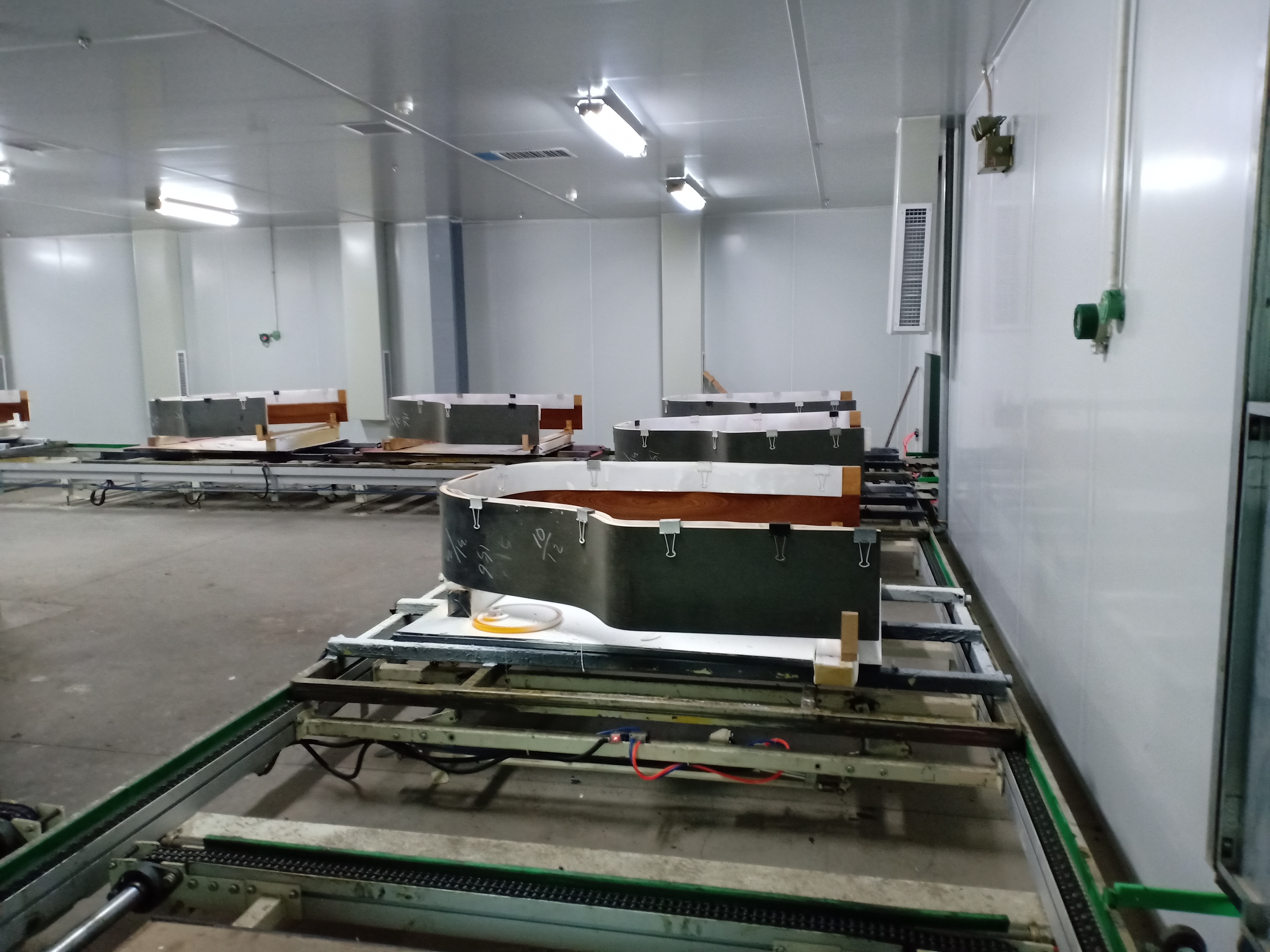
Step-by-Step: From Workpiece Loading to Cured Instrument Surface
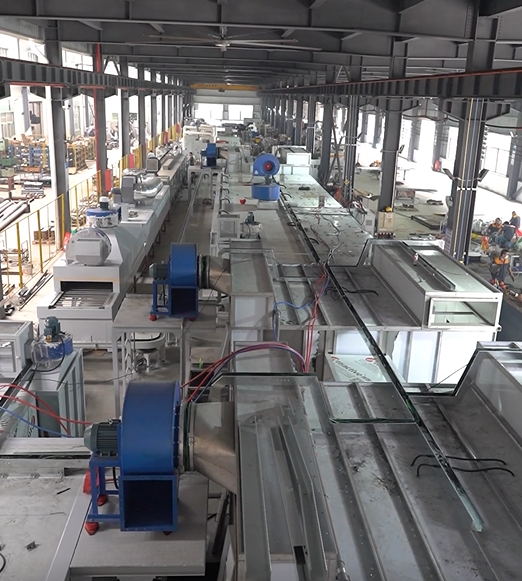
An automated coating line is organised as a sequence of modules rather than a single machine. The matched equipment set for this product family includes pretreatment equipment, drying equipment, an automatic sandblasting machine, a spray booth, a preheating oven, a curing oven, a cooling system, a conveying system, dust removal equipment, a VOCs treatment system, environmental protection equipment, an electrical control system, and an MES production management system. The sequence below reflects how those modules are typically arranged for wood-based instrument production.
- Workpiece loading and conveying. Instrument parts are placed on the conveying system at a pitch of 300 mm per hang. Loading discipline determines whether parts mark each other or sit stable through the ovens.
- Surface preparation and dust removal. Dust removal equipment keeps the surface clear before coating. On a wood line, this stage is where the majority of visible defects are either prevented or allowed to occur.
- Spraying in a stainless-steel booth. Coating is applied inside the spray booth. The booth and pipeline are stainless steel, which supports consistent cleaning routines.
- Pre-heating and flash-off. The preheating oven brings the substrate and film to a controlled condition so the coating levels correctly rather than skinning over.
- Curing. The curing oven completes film formation. Line speed is set here so that every workpiece receives the same dwell time at temperature, whatever its position on the conveyor.
- Cooling and unloading. The cooling system stabilises the film before parts are handled. Handling a warm instrument panel is a common source of marks.
- Air treatment and line control. VOCs treatment and environmental protection equipment manage exhaust, while the electrical control system and MES production management system record and sequence production.
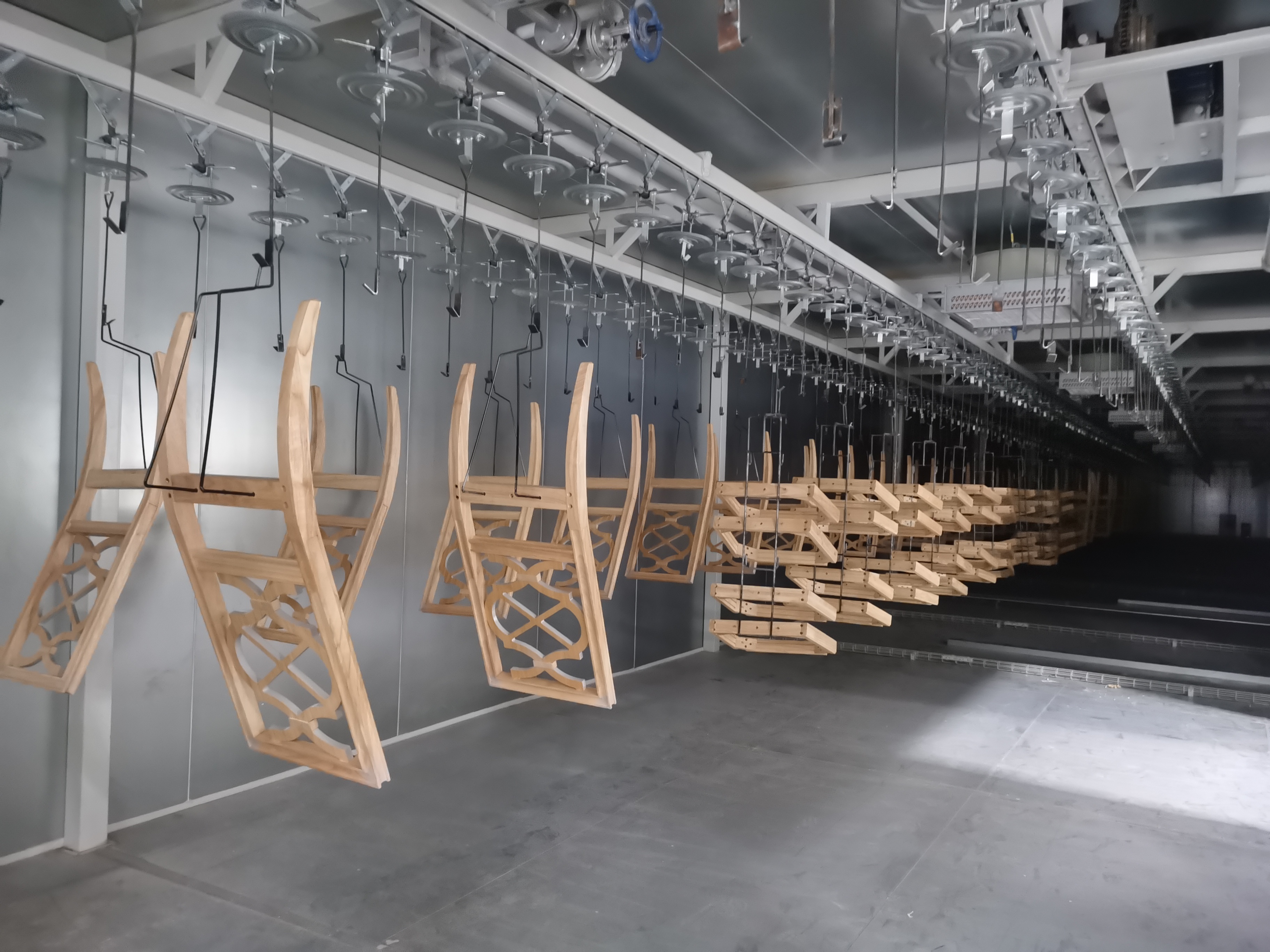
Use Cases: What the Wood Coating Line Actually Finishes
The Wood Coating Line is suitable for wood furniture and musical instrument industry applications. Within the musical instrument category, the named product types are guitar coating line, piano coating line, musical instruments coating line, and wood speaker coating line. Alongside them, the same platform covers wood beds, dining tables, and wood chairs, which is useful for plants that finish instrument parts and furniture components on the same floor.
Application scenarios range from new production lines to upgrades of existing lines and customised turnkey projects. This is relevant for instrument manufacturers who already own a manual or semi-automatic spray area: the project can be scoped as a partial upgrade, with conveying, spray, and curing modules replaced or added in stages, rather than as a complete greenfield build.
Installed applications of this equipment family are common in a number of markets, including Vietnam, Iran, Indonesia, Brazil, the United Arab Emirates, Turkey, Thailand, Saudi Arabia, Argentina, Mexico, Pakistan, Bangladesh, India, the United States, Russia, and Singapore. For an instrument producer planning export-oriented production, that footprint indicates the line can be supplied and supported across different regional conditions.
The operating environment is defined as an indoor Class 10,000 cleanroom with clean and well-ventilated conditions, which is consistent with the surface cleanliness instrument finishing requires. Lines are also used across a wider set of industries including automotive parts, cookware, heavy machinery, home appliance, building materials, and low-altitude equipment, so references and process experience are not limited to one sector.
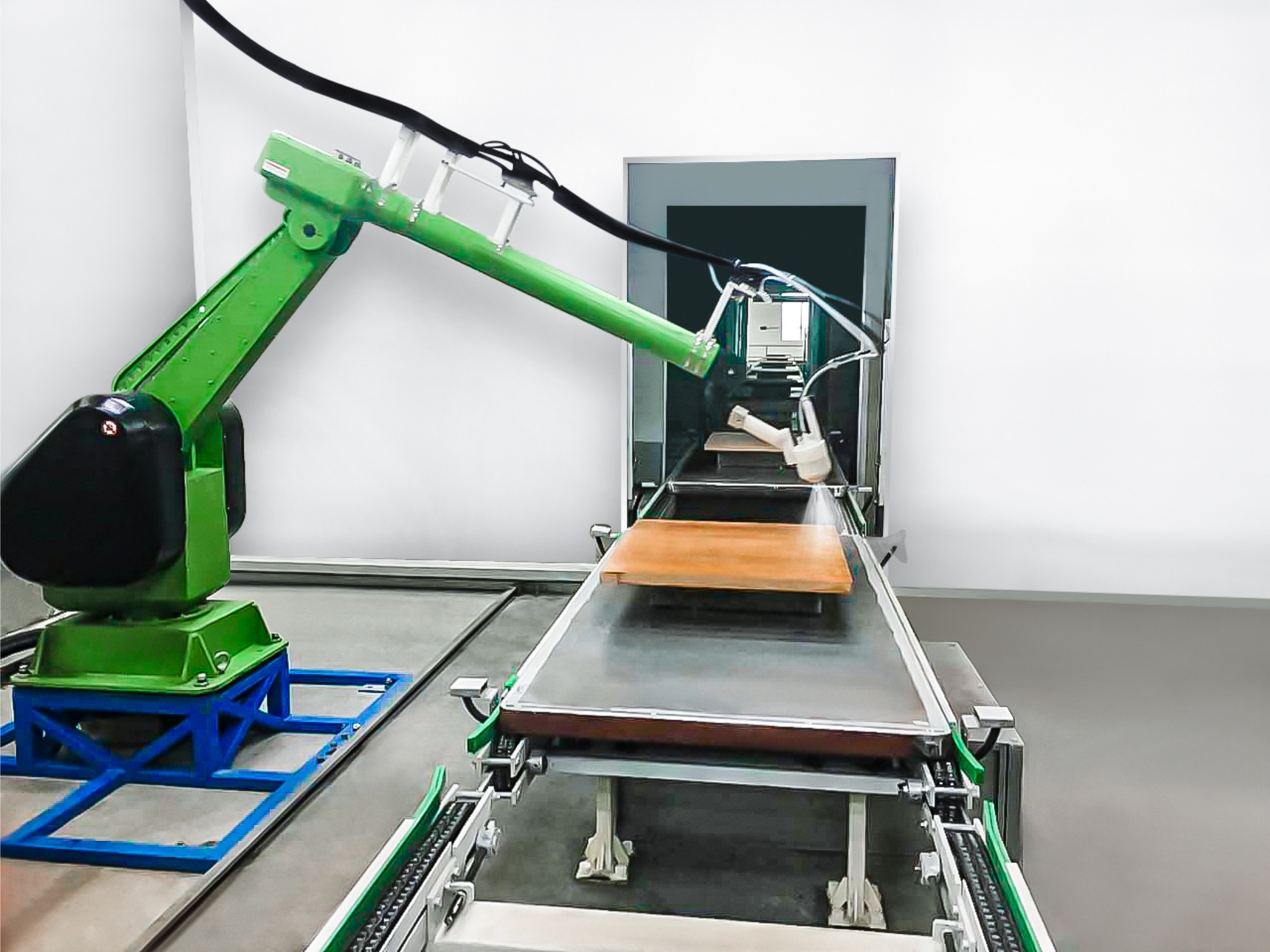
Comparison: Wood Coating Line Against Other Coating Line Models
Coating lines are not interchangeable between workpiece families, because conveying, spraying method, and speed range are all matched to the part. The table below compares the Wood Coating Line with four other models in the same product range using published equipment parameters. The purpose is to show what changes when the workpiece changes, not to rank one model above another.
| Coating Line Model | Typical Workpiece Material | Spraying / Working Mode | Speed and Capacity | Target Industry |
|---|---|---|---|---|
| Wood Coating Line | Solid wood, MDF | Automated coating with 300 mm pitch per hang; electrical energy | Design line speed 4000 mm/min, adjustable 2000–6000 mm/min; 1422 pieces per 8-hour shift | Wood furniture and musical instrument industry |
| Metal Coating Line | Aluminium panels and profiles | Reciprocator plus manual spraying; power and free conveyor chain; 300 days per year, 20 hours per day | Conveyor belt speed 3000 mm/min, adjustable 2000–4000 mm/min; up to 5000 m² per day | Hardware and building materials industry |
| Auto Parts Coating Line | ABS+PC | Offline mode plus robot spraying; 336 days per year, 22 hours per day | Spray booth 25±2 °C, 65±10% RH; equipment utilisation rate 85% | Auto parts industry |
| Cookware Coating Line | Aluminium alloy and composite materials | Automated cookware coating line | Standard product size Φ220×160 mm (H); maximum Φ300×160 mm (H) | Cookware and home appliance industry |
| Industrial Equipment Coating Line | Metallic, aluminium | Manual plus robot spraying; floor supported conveyor | 20 units of China railway gondola cars, flat cars, or tank cars per shift | Industrial equipment and low-altitude equipment industry |
The pattern is visible in the parameters. Metal and auto parts lines emphasise speed ranges and environmental control inside the booth, cookware lines are dimensioned by a round part envelope, and the Wood Coating Line is dimensioned by workpiece height up to 1400 mm together with a wide adjustable speed window. Instruments sit in the wood category because they share the substrate, the finish sensitivity, and the conveying requirement.
Frequently Asked Questions
1. Does a Wood Coating Line meet environmental compliance requirements?
Environmental compliance for this equipment family is defined around high efficiency, energy saving, and ease of maintenance, together with ISO14001, ISO9001, and ISO45001 environmental compliance requirements. In a complete line configuration, dust removal equipment and a VOCs treatment system are listed as matched modules alongside the spray and curing equipment, rather than as optional add-ons. For instrument plants facing local air-quality requirements, these modules need to be part of the plant layout from the start, because they affect floor space, ducting, and electrical capacity.
2. Can one Wood Coating Line run both guitar bodies and piano components?
Yes. Guitar coating line, piano coating line, musical instruments coating line, and wood speaker coating line are all listed categories within the Wood Coating Line product family. The line handles solid wood or MDF, with a standard workpiece size of 100 mm (L) × 50 mm (W) × 1400 mm (H) and a maximum workpiece size of 610 mm (L) × 710 mm (W) × 1400 mm (H), at a pitch of 300 mm per hang. The design line speed of 4000 mm/min is adjustable between 2000 mm/min and 6000 mm/min, so the same platform can be set slower for parts that need longer flash-off and faster for stable, high-volume workpieces.
3. What determines the budget for a wood coating line project?
Cost is normally quoted per project because no two plants have the same layout. The variables that move the number are engineering scope rather than brand: which modules are included (pretreatment, drying, spray booth, preheating oven, curing oven, cooling, dust removal, VOCs treatment, electrical control, and MES production management), whether the line speed needs to cover the full 2000–6000 mm/min range, and how much of the existing building and utilities can be reused. Buyers get a more comparable quotation by starting from an actual workpiece list and required output than from a supplier price list, because that is what allows each module to be sized against real production.
4. How can a buyer validate the line against real instrument workpieces before ordering?
Validation starts with the workpiece itself. Instrument parts are handled from a standard size of 100 mm (L) × 50 mm (W) × 1400 mm (H) up to a maximum of 610 mm (L) × 710 mm (W) × 1400 mm (H) on this line, so the first check is whether the actual guitar body or piano component fits the hanging method and the 300 mm per hang pitch. From there, the review covers coating stages, curing conditions, and how the part behaves at the intended line speed. New production lines, upgrades to existing lines, and customised turnkey projects are all within scope, which means an existing spray area can be assessed as a partial upgrade instead of a full replacement.
5. What manufacturing capacity and after-sales support stand behind the line?
The manufacturing facility covers 35,548 square metres with a total workforce of approximately 280 employees and an annual production capacity of 60 units. Once a line is running, a remote diagnosis system enables rapid troubleshooting and a 4-hour response service, and automated continuous production minimises downtime. Project timelines depend on the module scope and on plant readiness, which is why the module list is agreed before scheduling. The next step for most buyers is a scoped quotation based on workpiece drawings and required output, or a copy of the product catalogue for internal review.
Conclusion: Matching the Line to the Instrument, Not the Other Way Around
Instrument coating rewards process control. A Wood Coating Line built for the musical instrument industry keeps the decision points visible: a 2000–6000 mm/min adjustable speed so guitar and piano parts can each run at the right dwell time, a stainless-steel spray booth and pipeline to protect finish quality, a 300 mm pitch that lets throughput and finish be balanced deliberately, solid wood and MDF compatibility up to 610 × 710 × 1400 mm, and an 8-hour output of 1422 pieces per shift. Around those parameters sit the modules that decide whether a plant can meet its environmental obligations, from dust removal and VOCs treatment to MES production management.
For a plant in the awareness and research stage, the useful outcome of this guide is not a single specification number but a shortlist of questions: which modules are required, what speed range the mixed workload really needs, how the workpiece hangs, and what happens after commissioning. Answering those questions with real part drawings and real output targets turns a coating line from an equipment purchase into a production decision.
Next Step: Discuss Your Instrument Coating Project
Send us your guitar or piano workpiece drawings, required output, and plant dimensions, and we will map them against the Wood Coating Line configuration. You can also request the product catalogue for internal review.
Attractivechina — Guangdong Chuangzhi Intelligent Equipment Co., Ltd.
Email: attractivechina@gmail.com
Tel / WhatsApp: +86 135-8061-6025
Website: www.attractivechina.net
Address: No.2 Yingbin Avenue, High-tech District, Zhaoqing City, Guangdong Province, China
Catalogue download: Company brochure (PDF)
Have Questions or Need More Details?
Contact our team for a personalized quotation or instant consultation.
Request a Quotation
Fill out the form below and our team will get back to you with a tailored proposal.
WhatsApp Direct Chat
Prefer to chat in real-time? Message us on WhatsApp for instant assistance & quick answers.
- Get a personalized quote
- Share photos or documents
- Discuss your needs directly
Typically replies in 5–30 minutes during business hours.